

So, we often think of networking in terms of centralization. With Reticulum, there is no centralization, it is a networking protocol that allows us to place into service any number of ‘nodes’ on a network with each having as much authority on the network as any other ‘node’.
With this said, and with simplicity of explanation in mind, we should attempt to visualize the differences between ‘traditional’ networking and Reticulum networking concepts. As stated in my last post regarding Reticulum, the ‘traditional’ networking protocols have always been dependent upon a concept that removes the power of connection from the user, and places it into the hands of the provider. In a home networking instance, this doesn’t matter as much as it does in the world of the ‘internet’.
Control is always a commodity. In the day of the telegraph, the idea was born that those who control the information control the opinions and knowledge base of others. After all, prior to the advent of the telegraph, information took days, weeks, and months to reach the furthest outposts of ‘civilization’. Therefore, if an outpost is ignorant of the existence of a circumstance, then that outpost was easily controlled by simply restricting, or flooding the outpost with information ‘instantaneously.’ The content of that information became controlled by those who had control of the communication devices. The idea of treating information as a commodity was born with the advent of the telegraph, especially when a profit could be made.
Today, the telegraph industry evolved into the telephone industry, which then evolved into the internet industry. Those companies who were able to adapt to the changing of platforms being used to share information quickly, thrived and became the controllers of the networks which we use to spread that information. Forget to pay the bill and they cut your access to that topology off, instantaneously, and until you can then satisfy their demands to supply you with the service. These corporations weren’t alone, nor were they the first to recognize that controlling information flow was beneficial to them. before we had any electrically connected devices, we had men on horseback or foot transferring information between those who wished to communicate. Armies all around the world knew that if you could take out the messengers, the ability to coordinate between different units of the opposition armies was limited, which could lead to glorious victory.
We live in a world now where information inundates us daily, and it’s not by happenstance. Everyone from the internet service providers (ISP’s) to the ‘news’ outlets know that if they bury you in information, your opinions can be easily manipulated, and therefore your beliefs. Why? Because it is human nature to fall back on what makes us comfortable, which means that the internet has become a tangled mess of psychological operations, in every respect. Have something to sell? Inundate the market with advertisement on every platform, every network, and in every language. Have a cause? Same. We have become so inundated with information that we cannot emotionally separate from it, which means our society has become more and more agitated with each other, which is also exactly as it is designed. If you’re angry at me because I like the color purple, you forget to pay attention to the fact that your ability to use the internet just got more expensive when they raised your rates. The cause? Some guy in Angola (the country) just shot a bird and therefore oil costs went up. Riiiiight. Couldn’t be greed, right? I digress. Back to the visualization.
I have stated the information in the previous paragraphs simply to preface the visualization concepts that will be presented next.
A traditional network, whether it be your home WiFi, or the internet, are conceptually identical in every respect. A computer or device at location X is placed into the network and assigned an address. As described in the last post I made about Reticulum, that address is the only place information intended for that computer or device is sent, regardless of whether or not that device has moved in location. That information is sent there by the controller of the network, which is typically what we call a router. The router determines where the information is intended to be sent, and either forwards the information, or simply drops the information (forgets it) if there is no response from the addressed device. We use the term ‘star’ networking to describe this process.
Before I share a basic image of networking, let’s clear up a little confusion that always occurs when one isn’t familiar with how networking works (in the computer sense). There are two basic types of networking that we talk about to describe the networks. Those are LAN and WAN. WiFi is nothing more than a LAN that is sent via a radio transceiver forward and back, so let’s not confuse anyone with WiFi at the moment. The two terms, LAN and WAN, is where we will concentrate for the moment. LAN is simply an abbreviation for Local Area Network, which means that everything within the limits of your house, whether hard wired or on WiFi, is on your own LAN, or local area network. WAN is also simply an abbreviation for Wide Area Network, which indicates that it is a network that is assembled of multiple LANs within a specific region. Those regions, depending upon the ‘service providers’ include as many LAN’s as specified. A WAN can be a company’s entire network structure, or a service provider’s ‘region’ such as a city block, zip code, etc.
In each case, LAN and WAN, the networks are nothing more than a collection of devices that ‘speak’ to a router within a LAN, which then speaks to a WAN for processing the traffic. Large companies often have multiple WAN setups, with multiple LAN setups for each location they have. It could be as small as, say, a company in Orlando, Fl, has four offices spread throughout the city. Each office has their internal LAN, which then speaks to the headquarters’ WAN, which routes the traffic between locations so that Sally’s email reaches Bob’s computer. Every transaction is dependent upon addressing within the LAN, and the LAN then addresses within the WAN. Just like a house is located on a street, in a zip code, in a city, in a state, in a country. 123 Anywhere Street is a LAN, which is connected to a WAN of zip code 12345 (which technically makes up the LAN of the zip code but for simplicity, we don’t typically state this on purpose), which then connects to the WAN of the city, which then connects to the WAN of the state, then the WAN of the country, etc. Organizing the thought process between what makes a LAN and a WAN can be complicated, but it’s easiest to think of traditional networking as simply clusters of distribution. A WAN distributes traffic amongst many routers that then determine if the traffic is intended for a device within it’s cluster of internal routers, which then continue this process until the addressed device is handed the information. A WAN has many routers, a LAN has fewer routers.
Technically we could simplify everything by stating that the internet is nothing more than a network. The network is divided into its components. Our website resides on a computer, that resides in a LAN, that resides in a WAN, which resides on a larger WAN called the internet. We over complicate the thought process behind it. So, with that said, a basic network looks similar to the following.
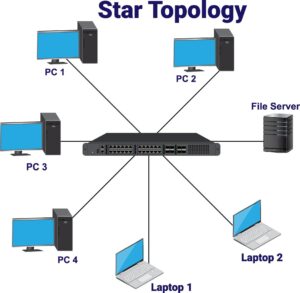
The most common form of networking, whether LAN or WAN is known as Star Topology. To avoid over complication, I won’t cover the other topological types here but I may mention one other type to describe redundancy for backup sake, but it will remain brief.
In the center of the diagram above, they show a router. That router is responsible for talking to each computer, organizing the addresses, and listing each device that is connected to it, so that traffic can be routed (hence the name router) between devices and reach the destinations intended. The traditional networking depends on what is called an IP address (Internet Protocol Address). That address consists of four groups of numbers divided by decimal points which is called IPv4 addressing. I am not going to cover the other types of IP addressing because their concepts are the same, but their structure is different. The only reason we need different types of IP addressing is because there is a finite (limited number) of address combinations that we can use, and with the growth of the internet throughout the world, we are reaching the limits of IPv4 unique combinations, so other forms have come into existence. Just know that they are the same in concept. In the diagram above, you may wonder how the router talks to the computers, and an outside network at the same time.
The router is assigned what is known as an external address and an internal address. Because the router is responsible for communicating inside the network to each device as well as outside the network to the internet, we address it with both internal and external IP addresses. Everything inside the LAN diagram above becomes one device, which is then recognized on another network which we call a WAN. They are identical in structure, differentiated by the addressing being external and internal. Identical in concept to receiving postal mail in the mail room of a company delivered by the postal service, and then routed to the CEO’s office, secretary’s desk, etc. inside the confines of the building.
Why am I digging so deep into this for you? Well, to eventually drive home the concept that traditional networking is limited by nature to the whims of the controller of the network(s). If the LAN in the diagram above is located in a company that hasn’t paid it’s bill for internet services, it becomes an isolated network. The devices connected to the network (LAN) inside the walls of the building will still talk to each other, however, external delivery of information is cut off at the external address of the network. We can continue to have our internal network, functioning as intended, but restricted to the walls of the building because we haven’t paid for the privilege of transferring information outside of the equipment we own as a company.
The designer of Reticulum had this in mind when he decided to conceptualize the way in which Reticulum works. Companies such as ISP’s, telephone providers, etc. cannot control what they don’t own. They do not own the air, or the airwaves (RF) that we enjoy as HAM radio enthusiasts. The government has decided, however, that those airwaves are within their purview to license, but I digress.
Reticulum, as a concept, is a stack, which is not confined to the limitations of paths to other devices like traditional networking. If I have a pile of papers, the information contained on those papers transfers through each piece of paper simply because they are within the same geographical space.
The addressing of each device in Reticulum is handled in a way that assigns a unique encryption method for each device. The method which is used, while finite, has trillions of trillions more possibilities than traditional addressing methods, including IPv6, because the addressing is performed by ‘hashing’ the name we give the device, the mac address of the device, and many other pieces of information that is contained within that device to come up with an encryption key that is unique to that device. The chances of another device matching that hash are less than on billionth of a percent. (If not smaller.) You stand a better chance of being in a plane crash, winning the lottery, getting hit by lightening, and being bitten by a shark in Kansas all at the same time than you do of duplicating an address in the Reticulum protocol. While it is not impossible, it would likely take a deliberate attempt to do so.
With these concepts in mind, how do we set up a Reticulum network?
Reticulum is a mesh networking concept. Mesh networking is a concept that is applied when we explain the network like a screen on a window. The devices communicate in all directions, repeating the traffic that has reached the device, which aren’t addressed to that device. Visualized in the following diagram.
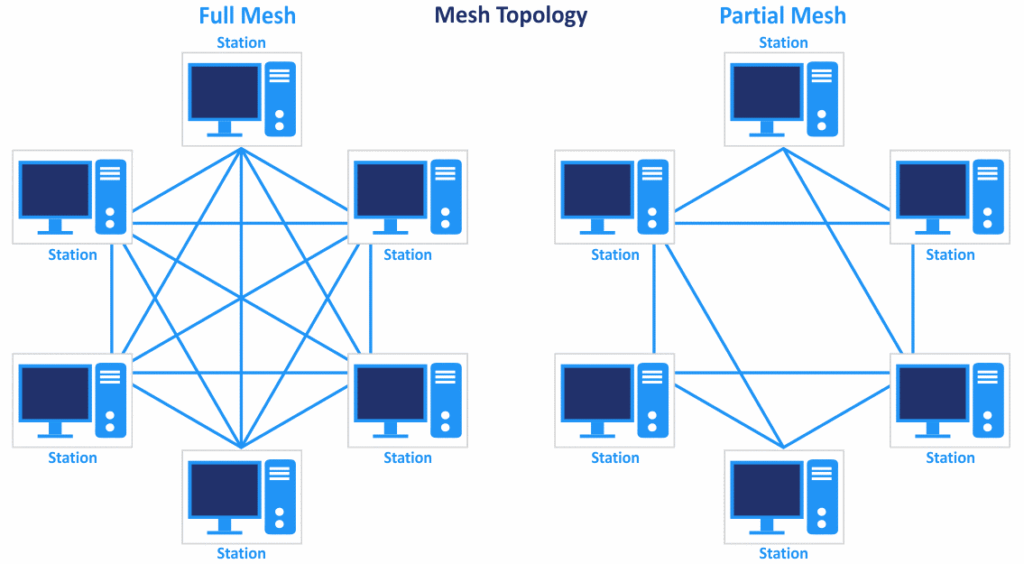
Note that in the above diagram, there is no centralized router. Each device acts as a router, which then repeats the information that is being sent until the intended target is reached. One problem that is noted with mesh networking is bandwidth.
Know that in HAM radio, we have limited bandwidth that we can use to talk over. The same concept exists in every electronic communication. The over run of bandwidth in mesh networking is handled by controlling how many ‘hops’ are used to transfer the information. A ‘hop’ is simply a retransmission of the data not intended for the device that is re-transmitting the information back onto the network. Each time a device determines the information isn’t intended for it, the hop count is incremented (adding 1) and when the set limit of ‘hops’ is reached, the devices then simply drop the traffic instead of repeating it. In Meshtastic, we are limited to a hop count of 7, which means even if we have devices between the sending device and the addressed device, if that count is higher than 7, the traffic will not reach the addressed device. We then handle that by determining if there is an alternate route, by attempting to limit the hops by geographical location. All of the devices in the hop group talk to each other and determine if one of the other devices are making contact with the addressed device, and if one is, the traffic is dropped or forgotten instead of repeated by the devices that have determined themselves to be outside of the hop limit. This explanation just got into the weeds, but I digress. Just know that with Mesh networking, the protocols are vastly different than traditional networking, with respect to how the addressing and delivery works. We can call it FM (freakin magic) as well as RF (radio frequencies).
Reticulum is not confined to hard data lines being run for networking to exist. It is independent of delivery method. The Reticulum ‘stack’ is nothing more than the organization behind how we present the information being transferred, and doesn’t care how that information is physically transferred.
In order to build ourselves a Reticulum mesh network, we can utilize WiFi routers with specific firmware, LoRa radios with specific firmware, AX.25 radios with or without specific firmware, hardwired networking structure, and any other method of carrying the information from one place to the other.
Because Reticulum isn’t dependent upon any singular delivery method, guess what? We are not bound to the whims of an ISP, telephone company, or even a government to allow us to network. It is truly an independent network delivery method. The only limitation to Reticulum networking is the limitation we place on it. We can utilize any other Reticulum network to deliver our information even if the devices on the other network don’t communicate with ours directly due to us having set up a network of only our devices. All traffic is encrypted, so even if a device isn’t on our network transfers the information, only devices on our network can decipher the information. Every other device not possessing the encryption keys simply forwards the encrypted information, just as a postal worker hands you an envelope not knowing what it contains. (Except we don’t x-ray the contents like the postal service would, as you cannot do so without the encryption keys!)
With all of the above said, I will be working toward understanding and implementing a network for us to use based on the Reticulum concept, utilizing as many methods as we can. By the way, typical networking requires that WiFi, routers, computers, etc. all ‘speak’ to each other at a standard speed, called baud rate. Reticulum actually handles cross communication between different baud rates by recognizing the speed limits of each on the network and automatically adjusting the transfer speeds, thus freeing us up to use multiple types of transfer methods such as LoRa, WiFi routers, hard wiring, etc. all at the same time, with delivery guaranteed if all devices are within the limits of the mesh! With that said, I will be experimenting with all types of delivery methods, as soon as I can get the different delivery methods available to me.
LoRa is limited by distance, where as AX.25 can be done on many different bands within the HAM radio spectrum increasing the distance which the RF can reach. WiFi is also adjusted for range. Also, there are methods to utilize the traditional internet to transfer between Reticulum mesh networks, which means we are only limited by our own ability to transmit the traffic in whatever methods we have available.
I suggest, if you have a desire to understand further, that you visit this website and look at the explanations straight from the designer of Reticulum. He communicates in a very technical manner, and if you have questions, I can attempt to translate for you, but you can learn a ton by visiting the site.
Understand this, at the very minimum. Reticulum is the network protocol to transfer information. There is a multitude of applications that utilize Reticulum to transfer information. Chat apps, texting apps, audio apps, etc. All available to us for the cost of simply taking the time to find them and install them. (Free)