
In order for you to build al Allstar node, you will need an interface that talks to both the Raspberry Pi and the radio of your choice. The interface is essentially a sound card, however it has functions built into it that allow you to have the radio automatically key when it is supposed to broadcast from the nodes you’re attached to, and to allow the ASL3 or HAMVOIP software to know there is incoming RF on the attached radio if you are broadcasting into it. The interfaces that we at The Zoo 2 have used are the DMK Engineering URIx-B, and the Allscan URI125.
As of this current writing, the DMK Engineering URIX-B is $149 and the Allscan URI125 is $69. There are advantages and disadvantages to both, but they are very similar in how they work, and both connect to the Raspberry Pi via USB.
With most Yaesu radios that may be used for ASL3, a 10 pin data cable is necessary. You’ll see in the following photos of the URIx-B and the Allscan URI125 that the inputs for each are vastly different. The URIx-B takes a 25 pin connector, and the Allscan URI125 takes a 6 pin data cable. Both companies sell the cables as well, but it is cheaper by a few bucks if you can build it.
The URIx-B:
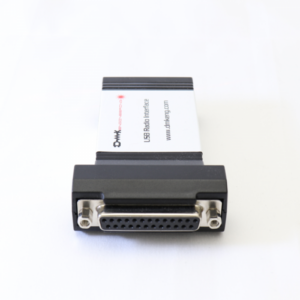
As you can see, the 25 pin cable has to be built to input the data from the radio’s data port. Because manufacturers vary their data output methods, a cable that fits your radio will have to be obtained. In most of The Zoo 2’s cases, we’ve used the Yaesu CT-167 10-pin to open wire cables to build a 25 pin connector for the URIx-B.
The Allscan URI125:
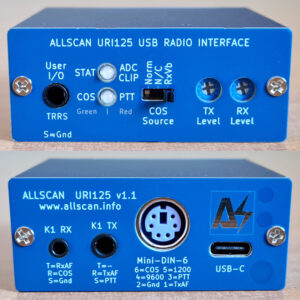
As you can see, the Mini-DIN-6 is the input for the Allscan URI125. This cable is available from Allscan, or you can purchase a 10-pin to 6-pin Yaesu cable. This unit also uses USB-C out to USB. This cable comes with the unit.
The advantages of the URI125 are that the RX and TX are paralleled so that you can use a Kenwood style microphone type cable from it to a handheld and skip using the Mini-DIN-6 on a larger radio should you choose, where the URIx-B would require that you tap into multiple spots within a handheld to work.
The Yaesu CT-167 cable:
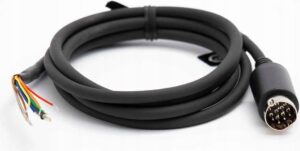
A suitable 25 pin connector can be purchased on Amazon, and I tend to purchase the terminal type versus the solder type to ease manufacturing the cable with respect to not having to solder the wires. They are much easier to use.
If you have any questions regarding the interfaces, please ask in the comments!
Until the next time,
~73, WF4RT
 AX.25 For Reticulum?