This post will delve into a very shallow look at how radio works, and is intended for the basic understanding. It is part of our ‘Elementary’ topics and is intended for those who have no experience in how things work, but an interest in learning. Who knows, you may find something in here useful, but if you’re an intermediate or advanced HAM radio enthusiast, this may also bore you to tears. Your choice, read it or don’t.
For those of you left, welcome to the basics of how our hobby works. We will first define what a radio wave is, and then we’ll look at a few different modes of operation that are most prevalent in our hobby. Always bear in mind that with any technology, modes of operation are application specific, so we may not touch on modes you won’t use in the HAM radio hobby, even if they exist.
What is a radio wave?
The basic radio wave was discovered around the year 1895 when Guglielmo Marconi discovered he could transmit Morse code via electromagnetic waves through the air without the need for wires to be attached anywhere in between the transmitter and receiver. He was lucky enough to have benefited from the works of Nicola Tesla who experimented heavily in the transfer of electricity through the air.
By 1837 the telegraph had been invented allowing information to be sent via wires at “great” distances and without the aid of written format being transferred physically from one point to another. Samuel Morse became involved in developing the use of the telegraph, inventing his code we call Morse code. A telegraph worked by switching what is called an oscillator on and off, which then sends a frequency over the wires. The length and pattern of switching that oscillator on and off became Morse code, and he standardized the code with a patent being applied around the year 1849, 17 years after the telegraph had been invented.
Standardization of the code allowed operators all around the world to send messages and allow other operators to decode those messages ‘easily’ as, prior to the standardization, local operators used coding that may have been similar, but based on region, completely different in timing, etc. Morse clarified those communications.
Fast forwarding to 1895, Marconi discovered that Tesla’s waves could be produced at known frequencies and therefore sent between points without the aid of wires. He further discovered that he could inject the oscillated signals into the base frequencies, now known as carrier waves, and upon the receiver ‘hearing’ the entire signal, the receiver could then nullify the carrier waves leaving just the injected oscillated frequencies to be processed or heard.
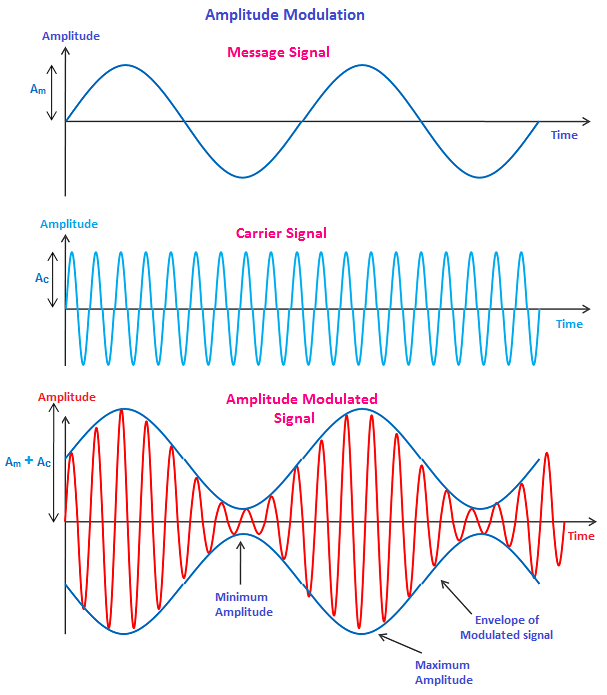
Nullifying of the carrier wave is called discrimination, which is the only form of discrimination that should be acceptable in the world. Bearing in mind that, at the time, Marconi had invented AM radio, or Amplitude Modulation radio, the form of transmission , known now as the mode, required the amplitude (or voltage above or below zero) to be altered to create the embedded signal onto the known frequency. Therefore, the frequencies involved remained the same, however, the voltage (known as amplitude) changed within the embedded signal on the carrier wave. Visually, the entire signal that is sent looks something similar to the following diagram, courtesy of the folks at Physics and Radio Electronics website (no affiliation).
Later down the line radio became a reliable method of communicating information at much greater distances than the telegraph allowed because of the fact that free air transmission allowed the transmissions to be sent without having to have relay stations in between destination and target operators due to resistance of the wire(s).
Until around 1896, when the first button microphone was invented, the information that was sent via radio waves was restricted to the standardized Morse code. Once the microphone was invented, Reginald Fessenden transmitted the first voice via radio in the year 1900.
Due to the nature of AM radio, the distances at which a signal could be sent were only limited by weather and other interference inducing phenomena making the signal on the receiving end too weak to process. AM radio frequencies easily bounce off of our atmosphere which makes it a good choice to use around the world, however, the application of audio injection complicates the reception issue. Due to the nature of voice communication, the multiple frequencies that make up verbal communication become the weak point in voice, or what HAM radio operators call phone, communication via AM transmission. The tendency then became simply restricting the type of transmission over AM radio to Morse code, setting the oscillators at standard frequencies so that operation in critical infrastructure remained uniform and reliable. We won’t get into the standards, here, as this is a basic concept post in our Elementary series, but if you’re interested in the standards, they are easily found via the search engine of choice on your web browser.
So in this section, you’ve learned that the basic radio wave is constructed of (looking at the image above) a carrier wave of a known frequency with an injected or embedded signal overlayed on top of the carrier signal and sent through the air. The mode of transmission called Amplitude Modulation was the first mode to be used, and then widely standardized.
Frequency Modulation
On November 5, 1935 Edwin H. Armstrong demonstrated for the first time what would become a tendency in the HAM radio community, in that he wasn’t satisfied with the state of AM radio with respect to audio quality and capabilities. One subject that has not been discussed in this article, which will remain simply mentioned but not explored, is bandwidth.
Simply put, bandwidth is nothing more than timing of the frequencies being used, both carrier wave and embedded waves, and the coincidence of the timing thereof. Bandwidth will be discussed in another, more advanced post, as we’re keeping this article basic in nature, so suffice to say when I use the word ‘bandwidth’ it is only to describe the benefit of one mode over another. Our site tagline ‘Where FM means more than Frequency Modulation’ is used intentionally, and the FM in that phrase means ‘Freakin Magic’.
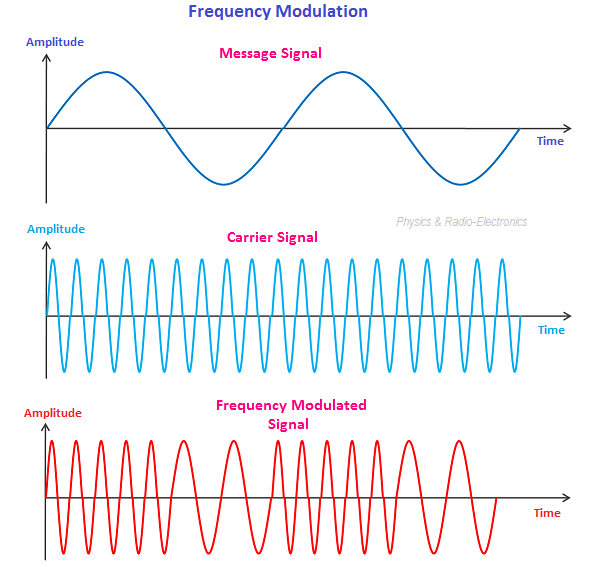
Back on task. Mr. Armstrong found that if he kept the carrier wave, and the embedded waves at the same amplitude, he could then inject, or modulate, the frequencies of the voice communications being sent at their own real frequencies, and then discriminate the carrier wave out leaving a much stronger signal being heard in the amplification stage of the receiver. Sounds awesome on the outset, right?
With every benefit comes detractors though, as with everything in life. Frequency Modulation, regardless of frequencies involved in carrier waves, tends to penetrate very well, making FM more difficult to send via bounce methods previously mentioned. FM radio penetrates the atmosphere very well, so what we term skip (bouncing a signal off of the atmosphere) tends to be difficult indeed, if not impossible.
This means that power comes into play. With AM radio, relatively low power stations can send signals with the skip method worldwide, with the benefit of adding power at the transmit stage being that stronger signals are received, but power independent. FM radio, on the other hand, is very power dependent. If you visualize your thumb over the end of a hose, you can visualize the concept of power. The tighter you hold your thumb (increasing power) the further your signal reaches in its natural arc.
With AM radio, even if you have your thumb only slightly holding pressure and the signal coming out is shallow in arc, the layers of the atmosphere can carry those waves further than expected, thus increasing the distance at which the signal is heard. With FM’s tendency to penetrate the atmosphere, the distance at which the signal can be heard is limited by line of sight, along with power.
The visual representation of how Frequency Modulation works is below, courtesy of the same website listed above.
With the advent of FM radio, audio quality was improved immensely because of the bandwidth gains that FM had over AM radio. Again, look for the tutorial that explains bandwidth in more detail, as in this lesson we’re just talking about how a radio wave works.
There are many other types of modulation that have come about since the advent of AM and FM radio modes, and it would serve you to learn about those we haven’t listed here, however in the HAM radio world, we typically don’t deviate from the AM or FM modes, even when we reference ‘modes’ as something other than Morse Code, or Voice (Phone).
To keep from confusing you, AM and FM modulation types are considered ‘modes,’ but we don’t typically reference the word ‘modes’ to describe them. When a HAM radio hobbyist is referencing ‘modes’ it most often means the type of transmissions we are making, which carries the self containing reference to the ‘mode’ (either AM or FM transmission type) that the referenced mode was ‘approved’ for. The following are ‘modes’ that you will hear a HAM radio hobbyist reference:
- Voice Modes (includes all modes of voice communications)
- Text Modes (CW or Morse code, Radioteletype, automatic link establishment, PACTOR, etc.)
- Image (Amateur television, slow-scan television (SSTV), etc.)
- Data Modes (DMR or digital mode radio, YSF or Yaesu System Fusion, D-Star or Digital Smart Technologies for Amateur Radio, FT8, FT4, and many others.)
With the different types of modes listed above, it is important to remember that each can technically be embedded in either AM or FM signals, however, the HAM radio community has our standards set by country, and agreement as to what modulation type we use when we are operating in the different modes. These can be referenced via the ARRL website, and through learning the modes which we use.
Practicality matters as well for some modes, and I mentioned bandwidth earlier in this writing, but suffice to say that certain frequency ranges work better for both AM and FM, and so we use almost exclusively AM or FM for those frequency ‘bands’. The three types of frequency ‘bands’ we use are:
- High Frequency (HF)
- Very High Frequency (VHF)
- Ultra High Frequency (UHF)
- Microwave (Rare, but used)
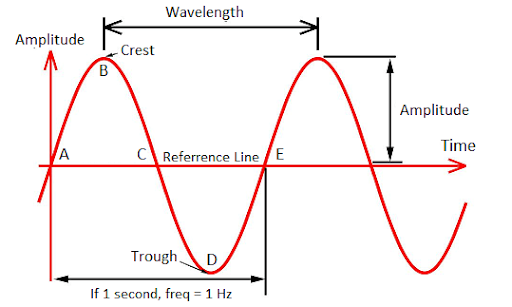
High frequency is the band of frequencies between 3 and 30 MHz. For reference, the time in which an AC wave (which a radio wave is) takes to cycle, or travel, from zero volts to peak high, back through zero to peak low, and back to zero again is one cycle, and the number of times a signal cycles a second is called a Hertz, symbolized by Hz. So for High Frequency, or HF signals, that is 3 million to thirty million cycles a second, symbolized by the M before the Hz.
Very High Frequency, or VHF signals are from 30 to 300 MHz and Ultra High Frequency, or UHF signals are from 300 MHz to 3 GHz, or 3 BILLION times a second. I dare you to blink that fast. Don’t do it, you’ll puke just trying.
With that said, I am going to conclude this writing, and direct you to the other elementary (Basic) courses for your understanding of the HAM radio hobby. Remember, though, the priority of the hobby is to have fun. Don’t allow yourself to be drawn in by the lids, and feel like you can’t ask questions. I will state for the record that obtaining a license is only the beginning. The real learning begins after you get your HAM radio license. We have so many reference sites available for you to learn the tests.
Most of the lids will argue that studying to pass the test, and studying for knowledge are two different things, which I can agree with, but that’s the point. The catch 22 is that if you don’t get licensed, you cannot learn our hobby, and you cannot get licensed until you learn our hobby. So, I will tell you to study for the test, (the questions and patterns to answering them), and then obtain the knowledge of how the FM (Freakin Magic) actually works. You’re only limited by your ability to learn, and your ability to learn is only limited by your willingness to delve into things you don’t understand, figuring them out on your terms, and then understanding becomes second nature. So drive on.
In closing, I’ll recommend that you visit HamStudy.org for your test(s) and continue studying for the tests until you can obtain 90% or more on each practice test consistently, through repetition of reading and clicking until you’ve memorized the correct answers for the questions, and you will pass the test as given by the VE’s. Go as far as you can, even to Extra, and after getting your license and a call sign associated with your name, come learn with the rest of us!
Until the next time,
~73, WF4RT
 AX.25 For Reticulum?